
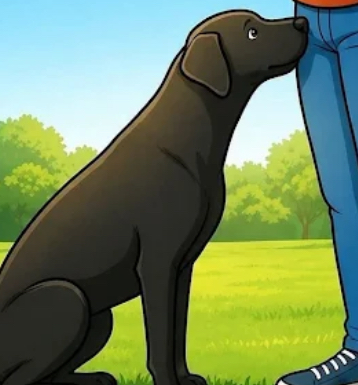
Why Dogs Sniff Your Private Areas: The Surprising Science Behind This Awkward Behavior
Picture this: a guest walks through your front door.
Your dog approaches quietly—not barking, not jumping, just observing with curiosity. Then comes the moment every dog owner knows all too well: the gentle nudge, the focused sniff, and the sudden realization that your pet has chosen a very personal area to investigate.
You blush. You apologize. You gently guide your dog away.
But what if that behavior isn’t rude at all?
What if your dog is simply saying hello in the most natural way they know how?
As awkward as it may feel to humans, experts say this behavior is deeply connected to the way dogs understand the world around them.
Dogs Experience the World Through Their Noses
Humans rely heavily on vision to gather information. Dogs, however, rely primarily on scent.
A dog’s nose is one of the most powerful sensory tools in the animal kingdom. While humans possess millions of scent receptors, dogs have hundreds of millions, allowing them to detect odors at concentrations that are almost impossible for people to imagine.
The portion of a dog’s brain devoted to analyzing smells is also dramatically larger, relative to size, than the equivalent area in the human brain.
To us, a quick sniff may seem insignificant.
To a dog, that same sniff can reveal an extraordinary amount of information.
In many ways, scent acts like a biography written in chemistry.
Why Do Dogs Sniff Certain Areas?
The answer lies in biology.
Dogs are naturally drawn to areas of the body that contain high concentrations of sweat glands, particularly the groin, armpits, and neck.
These regions release chemical signals known as Pheromones.
Although humans are largely unaware of these signals, dogs can detect and interpret them with incredible accuracy.
A simple sniff may provide clues about:
- Age
- Biological sex
- Emotional state
- Stress levels
- Recent activities
- Health changes
- Other animals or environments a person has recently encountered
While humans read facial expressions and body language, dogs often read chemistry.
That seemingly embarrassing sniff may simply be your dog’s way of asking:
- Who are you?
- Have we met before?
- Are you friendly?
- Are you feeling nervous or relaxed?
From your dog’s perspective, they are gathering information—not being impolite.
The Hidden Superpower Inside a Dog’s Mouth
Dogs possess another remarkable sensory tool known as the Vomeronasal organ, sometimes called the Jacobson’s organ.
Located in the roof of the mouth, this specialized structure allows dogs to detect and analyze pheromones in ways humans cannot.
Scientists often describe this process as “tasting” scent information.
This additional sensory system helps dogs gather social and biological information that remains completely invisible to us.
Sniffing Is Actually Good Canine Manners
Among dogs, sniffing is considered perfectly normal social behavior.
When two dogs meet, they rarely begin by making eye contact or exchanging vocal greetings. Instead, they gather information through scent.
For dogs, this is the equivalent of introducing themselves, shaking hands, and exchanging basic information all at once.
When your dog sniffs a visitor, they are often trying to understand:
- Is this person familiar?
- Are they comfortable around dogs?
- Have they been around other animals?
- Are they stressed or relaxed?
In canine society, skipping this step would be unusual.
Should You Stop Your Dog From Doing It?
The answer depends on the situation.
Occasional sniffing is normal and healthy behavior for dogs. However, prolonged sniffing or repeated attempts after someone moves away can make guests uncomfortable.
If necessary, gently redirect your dog’s attention using commands, treats, or toys rather than punishment.
Training can help dogs learn when greeting behavior is appropriate while still allowing them to satisfy their natural curiosity.
Positive reinforcement generally works better than scolding, as the behavior itself is not aggressive or harmful.
When Sniffing Might Signal Something Else
Although sniffing is usually normal, sudden changes in behavior can sometimes deserve attention.
If your dog becomes unusually fixated on one specific person or repeatedly investigates the same area, it may be worth mentioning to a healthcare professional or veterinarian.
Dogs have demonstrated remarkable abilities to detect certain medical conditions and physiological changes through scent, although this should never be considered a substitute for medical advice or diagnosis.
The Bottom Line
The next time your dog greets someone with an awkwardly timed sniff, remember that they are not trying to embarrass anyone.
They are simply using the language nature gave them.
Where humans use eye contact, conversation, and handshakes to make introductions, dogs rely on scent, chemistry, and instinct.
That uncomfortable moment at the front door may actually be your dog’s version of saying:
“Nice to meet you. Tell me your story.”